
Hazelnut Quality Parameters Explained: Moisture, Defects & Industrial Tolerances
Quality parameters play a critical role in hazelnut procurement, affecting roasting behavior, flavor, shelf life, refining performance, microbial stability and consumer- facing product appearance. This comprehensive guide breaks down all major quality tolerances used by exporters and manufacturers in the global hazelnut industry.
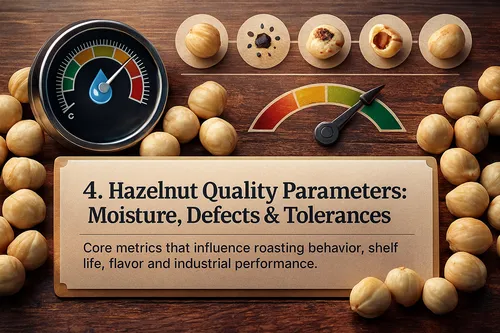
Why hazelnut quality parameters matter
Hazelnuts are purchased globally using standardized quality metrics. These parameters help food manufacturers predict behavior during roasting, grinding, enrobing, storage and formulation. Small variations in moisture, defect levels or microbiological stability can significantly influence yield, appearance, flavor and oxidative shelf life.
Turkish exporters follow internationally recognized tolerance systems that align with confectionery, bakery, paste, roasting and snacking industry requirements.
1. Moisture content: the most important single parameter
Moisture affects roasting performance, microbial safety and the oxidative stability of oils. Typical industrial moisture tolerances:
- 3.0–5.0% moisture: standard for raw kernels
- 2.0–4.0% moisture: optimal for even roasting and longer shelf life
- Below 2%: can lead to internal brittleness and fragmentation
Moisture drives how evenly the kernel heats during roasting. Excess moisture can result in underdevelopment, while too little can lead to scorching or premature oil oxidation.
2. Defect classifications used in the hazelnut industry
Hazelnut defects are categorized based on visual, structural and microbiological factors. Each defect type influences processing behavior and final product appearance.
Major defect categories
- Shriveled kernels: reduced oil content, dry texture, inconsistent roasting.
- Mouldy kernels: safety risk; strictly controlled by industry standards.
- Dark or stained kernels: acceptable within limits; mainly a cosmetic defect.
- Broken kernels: impact yield and are unsuitable for whole-nut applications.
- Inner mold (hidden defects): detected via cutting tests and x-ray scanning.
Exporters use optical sorters, manual sorting tables and cutting tests to remove defective kernels and maintain compliance with buyer specifications.
3. Standard tolerance ranges for industrial buyers
Tolerances vary by destination market (EU, Middle East, Asia-Pacific), but typical values include:
- Shriveled kernels: 1–3% depending on grade
- Broken kernels: 1–5% (whole kernels category)
- Dark/stained kernels: 1–4% depending on visual requirements
- Mouldy kernels: 0% tolerance
- Foreign matter: 0% tolerance
Premium confectionery grades usually demand tighter tolerances, particularly for color uniformity and broken kernel percentage.
4. Microbiological parameters for hazelnut safety
Although hazelnuts are low-moisture foods, microbiological stability remains essential for long shelf life and regulatory compliance.
- Total Plate Count (TPC): should meet food safety norms and buyer expectations.
- Yeasts & moulds: controlled through proper drying and storage conditions.
- Pathogens: Salmonella must be absent in 25 g.
- Aflatoxins: tested routinely; compliant lots receive certified lab reports.
Exporters regularly test each lot according to EU and Codex Alimentarius standards.
5. Optical sorting & quality assurance processes
Modern hazelnut processors rely on multi-stage quality systems to ensure defect-free lots, including:
- Optical color sorting for dark, stained or foreign kernels
- X-ray scanning in premium production environments
- Manual sorting lines for finishing and retail-grade quality
- Moisture testing at multiple processing stages
- Cutting tests to check internal mold or hidden defects
This ensures consistency for chocolate makers, ingredient manufacturers and private-label brands.
6. How quality parameters affect industrial performance
Each parameter influences downstream processing differently. For example:
- High moisture: uneven roasting, risk of microbial activity.
- Broken kernels: reduce yield for whole-nut chocolate and snacking uses.
- Dark/stained kernels: cosmetic issues for premium consumer products.
- High shrinkage: lower oil content, weaker flavor development.
- High defect levels: affects paste texture and oxidative stability.
Manufacturers often request custom tolerances linked to specific production requirements.
7. What buyers should include in their quality specification
When requesting a quote or product sample, buyers should specify:
- Target moisture level
- Maximum tolerances for shrivel, stain, mold and breakage
- Calibration size (e.g., 11–13 mm, 13–15 mm)
- Format (raw, blanched, roasted, chopped, sliced)
- Required documentation (COA, aflatoxin report, microbiology report)
- Destination market requirements
Providing detailed tolerances allows exporters to allocate the correct grade and ensure quality consistency.
Need specific hazelnut quality grades?
Share your required tolerances and application to receive a tailored quotation.