
Hazelnut Paste & Praline Manufacturing: A Complete Technical Breakdown
Hazelnut paste and praline (hazelnut-sugar blends) are core ingredients in chocolate, confectionery, spreads, gelato and bakery applications. This guide explains each technical step: roasting, fat release, grinding, refining, particle size control, viscosity adjustment, sensory development and industrial QA requirements.
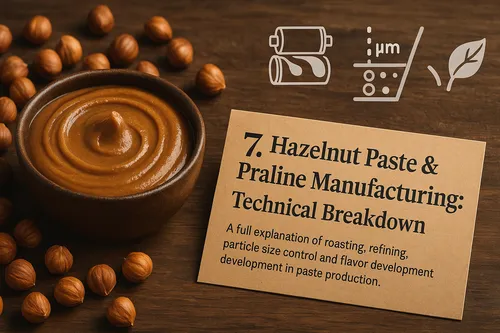
Hazelnut paste vs hazelnut praline: What's the difference?
Although often grouped together, hazelnut paste and praline differ technically in composition, processing and functionality:
- Hazelnut paste: 100% roasted hazelnuts milled into a smooth, fluid mass.
- Praline: A blend of roasted hazelnuts and caramelized sugar (typically 50–70% nuts).
Paste is used for flavor enhancement and fat contribution, while praline adds sweetness, viscosity and caramelized notes ideal for fillings and premium confections.
1. Roasting: The foundation of flavor & fluidity
Proper roasting is essential because it shapes both flavor and processing behavior:
- Flavor: Maillard reactions create aroma compounds that define paste quality.
- Fat release: Roasting unlocks bound oils, enabling natural fluidity during grinding.
- Color: Roast level determines the browning of the final paste.
- Moisture: Reduction to ~2% improves shelf life and processing efficiency.
Industrial users often request specific roast targets (light/medium/dark) based on desired sensory output in spreads, pralines, gelato or couverture systems.
2. Grinding & refining: Creating a smooth, uniform paste
Grinding transforms roasted kernels into a fluid mass by breaking cell walls and releasing oil. Particle size distribution is one of the most critical quality parameters.
Typical industrial particle size targets:
- Paste: 20–40 microns (smooth, fluid, used in spreads & fillings)
- Praline: 18–22 microns (required for confectionery fillings)
Equipment commonly used includes:
- Ball mills
- Stone refiners
- Pin mills / colloid mills
Over-refining can cause excessive heat generation, leading to fat separation, viscosity loss and flavor degradation. Process control is essential.
3. Fat content & viscosity: How they influence performance
Hazelnuts naturally contain 55–65% oil, which determines paste fluidity. Industrial users often specify viscosity ranges depending on application:
- Low-viscosity paste: ideal for blending into chocolate or praline systems.
- Medium-viscosity paste: suitable for spreads, gelato ripples and fillings.
- High-viscosity praline: preferred in laminated pastry fillings and molded pralines.
In pralines, sugar reduces free oil mobility, increasing structure and creaminess.
4. Praline manufacturing: Sugar, caramelization & blending
Traditional praline production involves:
- Roasting hazelnuts to the desired aroma and color profile.
- Caramelizing sugar to a specific color (light amber to dark).
- Cooling and mixing nuts + caramelized sugar.
- Grinding the mixture to a smooth, creamy texture.
The sugar addition provides sweetness, structure, and a distinct caramelized note that differentiates praline from pure paste.
5. Industrial quality requirements
Buyers typically specify:
- Particle size range and variability limits.
- Roast profile matched to flavor targets.
- Free oil levels to prevent separation.
- Peroxide value (PV) and oxidative stability.
- Fat content and total solids for formulations.
- Shelf life guarantees under sealed condition.
Lots may also include aflatoxin test results, microbiological analyses and certificates of origin.
6. Applications across food manufacturing
Paste and praline are used extensively in:
- Chocolate fillings & praline layers
- Spreads, creams & premium nut butters
- Gelato & frozen desserts
- Bakery fillings & laminated pastries
- Confectionery coatings & truffles
- Plant-based dessert systems
Hazelnut paste is favored for clean-label applications, while praline dominates premium confectionery and chocolate making.
Looking for hazelnut paste or praline for your production line?
Share your particle size target, viscosity preference and sugar ratio. We will prepare a tailored offer from Turkey.