
Export Logistics for Hazelnuts
Exporting hazelnuts involves a highly coordinated logistics chain—from inland transportation and warehouse consolidation to container loading, documentation, inspections, and international freight. This guide explains how hazelnuts move from Turkey to factories, roasters and importers worldwide.
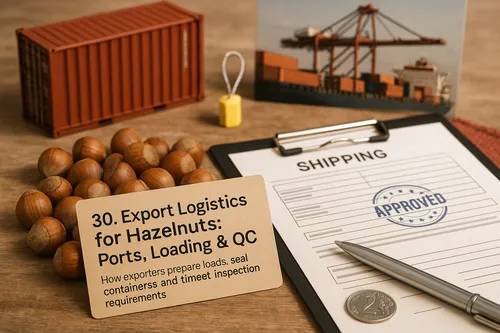
1. Main Turkish ports used for hazelnut export
Although hazelnuts are primarily grown in the Black Sea region, most exports move through several major ports that offer direct container services to Europe, Asia and the Americas.
Common ports of loading (POL):
- Trabzon Port – closest to growing areas; excellent for regional shipments.
- Ordu–Giresun – increasingly used for exports from central Black Sea areas.
- Samsun Port – high capacity, strong logistics infrastructure.
- Ambarlı / Istanbul Port – largest global connectivity, ideal for long-haul routes.
- Gebze / Kocaeli – preferred for exporters consolidating cargo near Istanbul.
Port selection depends on freight rates, vessel schedules, container availability and the exporter’s inland logistics setup.
2. Inland transport & warehouse consolidation
Hazelnuts typically undergo cracking, sorting and packing in processing facilities located near Giresun, Ordu, Trabzon and Düzce. Once ready, palletized cargo is moved via:
- 20 ft or 40 ft trucks for shorter inland distances.
- Reefer trucks if temperature control is required (rare, but used for long delays).
- Container pre-loading at warehouse sites for efficiency.
Many exporters operate consolidation warehouses to store multiple lots until the shipment is complete. This allows for QC checks, pallet configuration, traceability and final packing.
3. Container loading: ensuring stability & food safety
Proper container loading is essential for protecting hazelnuts during long sea voyages. Errors during loading can lead to moisture exposure, physical damage, infestation or temperature fluctuations.
Typical best practices include:
- Using food-grade, clean, dry containers with no odors or residues.
- Installing desiccant bags to reduce moisture accumulation.
- Protecting pallets with kraft paper floor lining to minimize condensation contact.
- Verifying container seals and recording seal numbers for documentation.
- Even pallet distribution to avoid shifting during transport.
Some buyers request third-party inspection (e.g., SGS) during loading to confirm quality, packing conditions and container sealing.
4. Export documentation required for hazelnuts
Each shipment requires a standardized set of export documents that comply with both Turkish regulations and the importer’s national requirements.
Core documents include:
- Commercial Invoice – quantity, price, Incoterms, and specification reference.
- Packing List – pallet count, bag count and net/gross weights.
- Certificate of Origin – issued by chambers of commerce.
- Phytosanitary Certificate – required by most countries.
- Health Certificate – ensures food compliance at destination.
- Bill of Lading (B/L) – issued by the carrier once the container is loaded.
- Laboratory test reports (aflatoxin, moisture, microbiology) when required.
Proper documentation prevents customs delays and ensures smooth clearance at the destination port.
5. Incoterms commonly used in hazelnut export
Exporters and buyers agree on Incoterms to define responsibilities regarding freight, insurance, risk and delivery point.
- FOB (Free on Board) – most common; buyer arranges sea freight.
- CFR (Cost & Freight) – exporter arranges the freight; buyer handles insurance.
- CIF (Cost, Insurance & Freight) – exporter covers freight + insurance.
- DAP (Delivered at Place) – used for specialized logistics or emerging markets.
Most large importers prefer FOB for flexibility in selecting carriers and consolidating loads.
6. Typical freight routes & transit times
Transit times depend on port of loading, vessel schedule and transshipment hubs.
Approximate durations:
- Europe: 5–12 days
- Middle East: 10–20 days
- South Asia: 20–30 days
- East Asia: 25–40 days
- North America: 25–45 days
- South America: 30–55 days
Transit time should be considered when selecting packaging format, especially for roasted or high-fat products such as hazelnut paste or oil.
7. Quality control before shipment & at loading
Quality assurance is integrated into every stage of export operations. Buyer-specific QC programs are common in long-term supply agreements.
Standard QC procedures include:
- Sampling and testing each lot for aflatoxin, moisture and defects.
- Visual inspection of bag stitching, labeling and pallet integrity.
- Review of traceability records and production dates.
- Optional third-party pre-shipment inspection.
Strong QC practices reduce claims, shorten customs inspections and ensure consistent repeat orders from demanding markets.
8. What importers should monitor during hazelnut shipments
Importers play an important role in ensuring smooth clearance and efficient supply flow.
- Check all documents before vessel arrival to avoid demurrage.
- Confirm that seal numbers match the packing list and B/L.
- Request COI, health certificate and lab results early.
- Plan transportation from port to factory to minimize storage time.
Proactive communication between exporters, freight forwarders and importers ensures a smooth export experience from Turkey to the final destination.
Need support with hazelnut export logistics?
Share your destination port, preferred Incoterms and volume requirements. We will coordinate a tailored logistics plan for your program.